

Remodel or Move: Weighing Your Options in the Fort Worth Market
If you’re outgrowing your home in Fort Worth, Keller, Southlake, Mansfield, Arlington, or Aledo, you’re facing one of th …
Flooring is one of the most visible and most felt decisions in any remodel. It covers more square footage than almost anything else in your home, it’s underfoot every single day, and it has a direct impact on both the look of your space and its long-term performance. In North Texas, climate plays a bigger role in flooring selection than most homeowners realize — and what works perfectly in one home may be the wrong choice in another.
At Stanton & Co., we work through flooring decisions with homeowners across Fort Worth, Keller, Southlake, Mansfield, Arlington, Aledo, and the surrounding Tarrant County area every day. This blog compares the materials that come up most often — porcelain tile, natural stone tile, LVP, engineered hardwood, solid hardwood, and carpet — across durability, climate performance, allergy considerations, longevity, resale value, installation, and pricing.
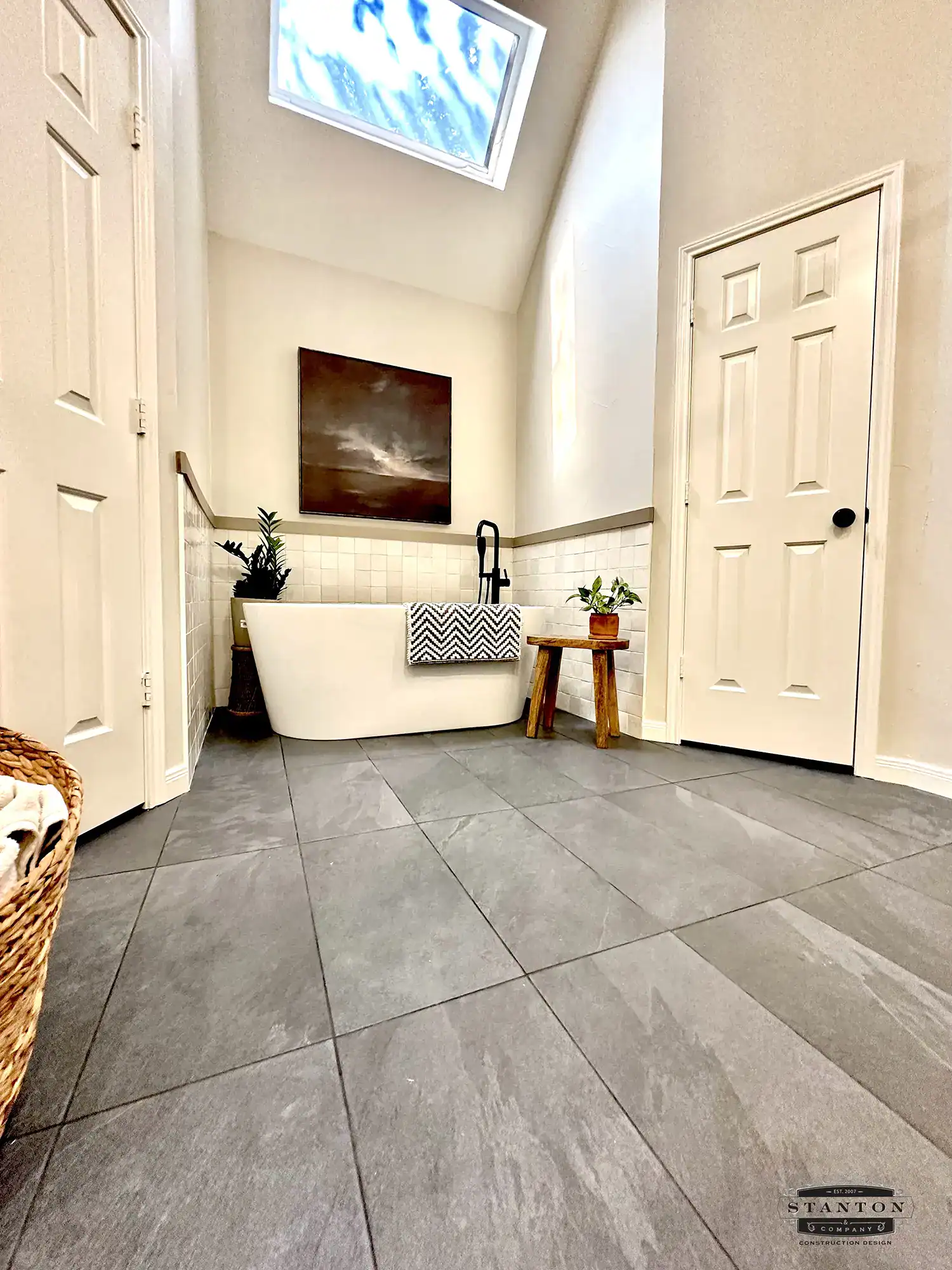
Porcelain tile is made from a carefully refined blend of clays, pressed under high pressure and fired at extremely high temperatures — typically over 2,000 degrees Fahrenheit. That process produces one of the densest, hardest, and most moisture-resistant flooring materials available. It is a go-to choice for kitchens and bathrooms, and large-format wood-look porcelain has expanded its reach into main living areas throughout the DFW market. A word on porcelain versus ceramic: both start from clay, but porcelain’s denser mixture and higher firing temperature produce a harder, far less porous tile. For floors — where the surface takes daily foot traffic and moisture — we generally specify porcelain over ceramic. The long-term performance difference justifies it.
Durability: Scratch-resistant, stain-resistant, and completely impervious to moisture. Will not warp, cup, or react to humidity. The primary risk is impact — a dropped heavy object can crack an individual tile, which is why keeping spare tiles from your installation is always recommended.
Fort Worth Climate: The most climate-compatible flooring material for the DFW area. Unaffected by humidity swings and installable directly over concrete slab without moisture barriers or acclimation.
Allergy Considerations: Excellent for allergy sufferers. Hard, non-porous surface traps no dust, dander, or allergens. Does not off-gas.
Longevity: 50 years or more with proper care. Grout lines require periodic resealing; individual cracked tiles can be replaced if spares are kept on hand.
Resale Value: Expected in kitchens and bathrooms; a positive in main living areas when neutral and timeless styles are selected. Bold or trend-driven choices can work against resale.
Installation: Labor-intensive and requires a skilled installer. Subfloor must be perfectly flat — any flex will cause tiles to crack at grout lines over time. Large-format tiles require additional back-buttering techniques. Layout direction and pattern must be finalized before installation begins. No acclimation required. Order 10% overage; dye lots vary between production runs.
Pricing: $10–$25 per square foot installed for standard sizes. Large-format tile and complex patterns push toward $20–$40. Subfloor leveling is an additional cost if needed.
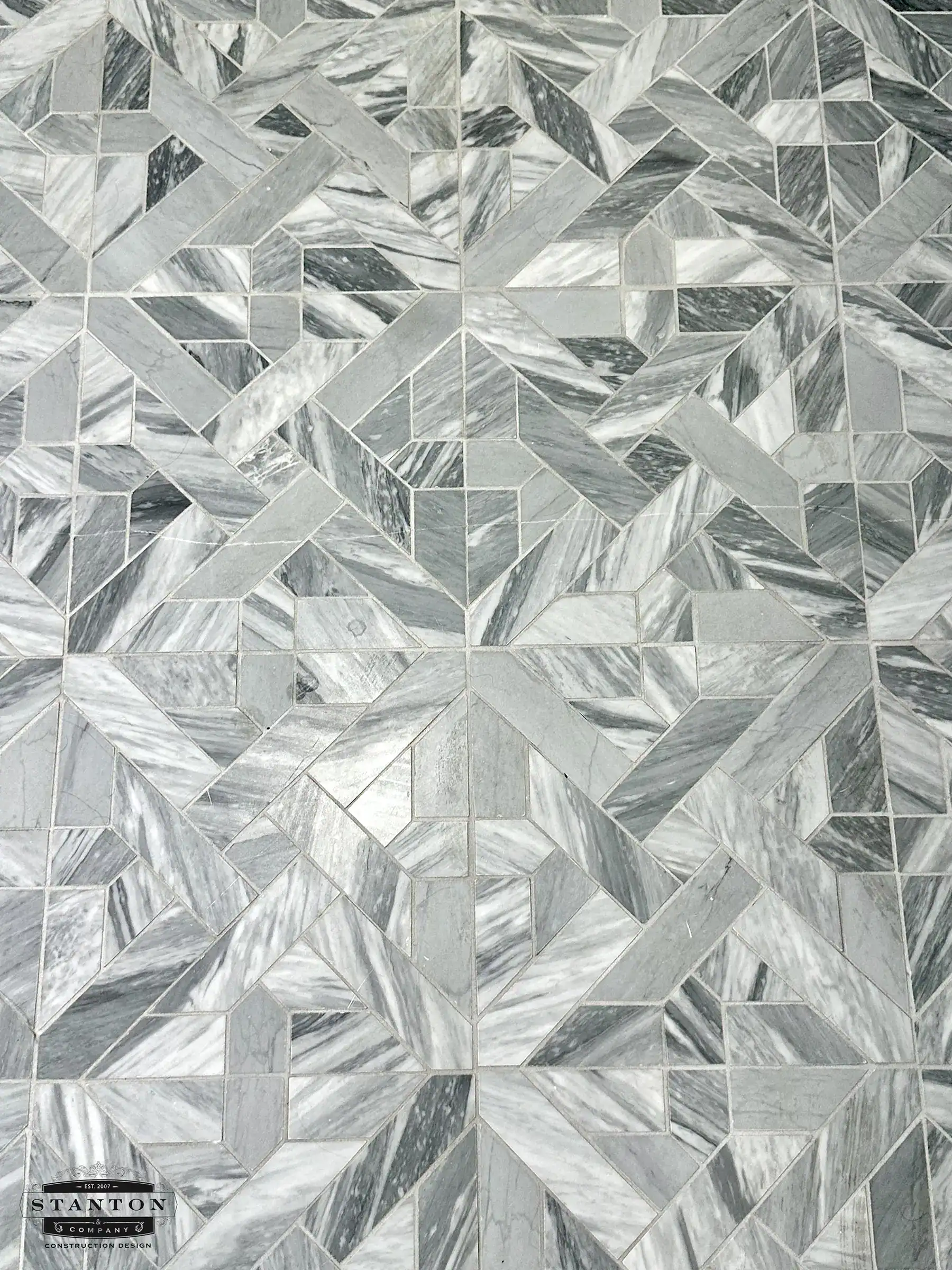
Natural stone tile is cut and finished directly from stone quarried out of the earth. Unlike porcelain, which is manufactured to a consistent specification, every piece of natural stone is unique — color, veining, texture, and character vary because no two sections of stone are identical. The three most commonly specified natural stone tile materials in residential remodeling are granite, marble, and travertine.
Granite Tile: An igneous rock formed from cooled magma, with a speckled, crystalline appearance. One of the hardest natural stones available — highly resistant to scratching and heat, and well suited for high-traffic flooring. Porous and requires sealing, but its density makes it more stain-resistant than softer stones.
Marble Tile: A metamorphic stone with distinctive veining and a luminous surface that defines luxury interiors. Brings unmatched elegance to entryways, formal areas, and primary bathrooms. As discussed in our Countertop Materials blog, marble is softer and more porous than granite — susceptible to etching from acidic substances and requires diligent maintenance. Best suited for lower-traffic areas and homeowners committed to its care.
Travertine Tile: A form of limestone formed around mineral springs, with a warm palette of creams, tans, and golds. Its naturally porous, pitted surface — those characteristic holes and voids — are part of its identity. For interior flooring, filled and honed travertine is the most practical specification. Softer than granite and better suited for moderate-traffic areas. A timeless choice for Mediterranean, Tuscan, or transitional-style homes common throughout the Fort Worth area.
Durability: Varies by type. Granite handles high traffic well. Marble is hard but susceptible to etching and scratching in busy spaces. Travertine is the softest of the three and best for moderate-traffic areas. All three require sealing and can chip under direct heavy impact.
Fort Worth Climate: Dimensionally stable and unaffected by humidity swings — will not warp or move with moisture changes the way wood products do. Stays naturally cool underfoot, a genuine comfort benefit in a North Texas summer. Moisture from older slab foundations must be addressed before installation since natural stone is porous.
Allergy Considerations: Excellent for allergy sufferers. Hard surface traps no allergens. Clean with stone-safe, pH-neutral cleaners. Grout lines require regular cleaning.
Longevity: 50 to 100 years with proper care and maintenance. Granite is the most low-maintenance of the three. Marble develops a patina over time and can be professionally restored. Travertine requires sealing every one to two years; marble annually in high-use areas; granite every one to two years.
Resale Value: Consistently commands a premium perception. Marble, travertine, and granite in entryways, kitchens, and bathrooms signal craftsmanship that buyers notice. Neutral tones and classic patterns deliver the strongest return.
Installation: Among the most demanding of any flooring category. Subfloor must be perfectly flat and structurally reinforced where needed — stone will crack over any deflection. Granite requires strong adhesive; marble is vulnerable to chipping during cutting; travertine must be sealed before grouting to prevent grout absorption into voids. All natural stone must be sealed immediately after installation. No acclimation required, but slab moisture testing is essential. Order 10–15% overage — matching from a different quarry lot later is often impossible.
Pricing: Granite tile: $12–$30 per square foot installed. Marble tile: $18–$40 per square foot installed; high-demand varieties like Calacatta can exceed $40. Travertine tile: $15–$35 per square foot installed for standard and premium residential grades. Subfloor preparation, moisture mitigation, and pattern complexity are additional cost factors across all three.
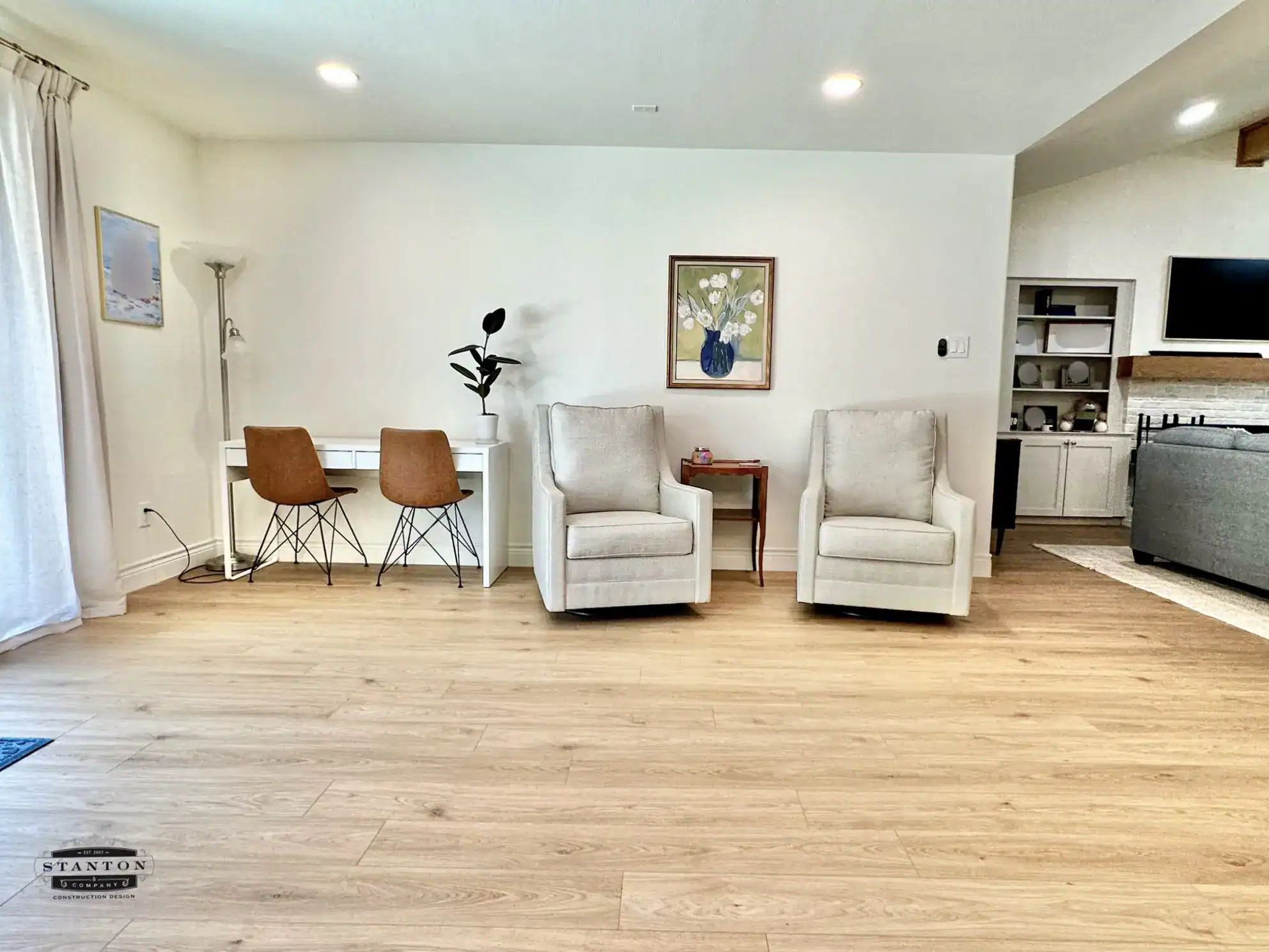
Luxury Vinyl Plank — commonly called LVP — is a multi-layer synthetic flooring product engineered to replicate the look of hardwood. It combines a realistic wood appearance with waterproof performance, straightforward installation, and a price point well below natural wood. At Stanton & Co., it is among the materials we install most frequently.
Durability: Waterproof and scratch-resistant under normal use. Wear layer thickness — measured in mils — determines long-term performance. Use a minimum 12-mil wear layer for residential applications; 20-mil and above for high-traffic areas or homes with pets. Quality varies widely between products.
Fort Worth Climate: Performs well in the DFW climate — waterproof and unaffected by normal humidity. Rigid-core LVP can expand and contract with extreme temperature swings in rooms that are not consistently climate-controlled.
Allergy Considerations: Good choice for allergy-sensitive households. Hard surface traps no allergens. Specify FloorScore or GREENGUARD-certified products to avoid VOC off-gassing concerns.
Longevity: Manufacturer warranties of 15 to 30 years in residential applications. Cannot be refinished — when the wear layer is gone, replacement is required. Wear layer thickness at time of selection determines lifespan.
Resale Value: Viewed positively by buyers as a low-maintenance upgrade over carpet or laminate. Does not carry the premium perception of hardwood or natural stone, but a quality installation is a selling point in today’s market.
Installation: Floating floor system — planks click together without gluing or nailing, allowing natural expansion and contraction. Subfloor must be clean and flat. Installation over a moisture barrier is imperative on slab-on-grade foundations to prevent moisture wicking from concrete — Stanton & Co. installs a moisture barrier as standard practice on all LVP installations over slab. As noted in our What to Expect When Remodeling blog, LVP must be acclimated to your home’s temperature and humidity for 48 hours before installation. This step is critical and cannot be skipped. As with countertop selections discussed in our Countertop Materials blog, these details are best resolved during the design phase before work begins. Order 10% overage; production run consistency can vary.
Pricing: $5–$12 per square foot installed for quality residential products. The most cost-effective option for a wood-look floor across large areas.
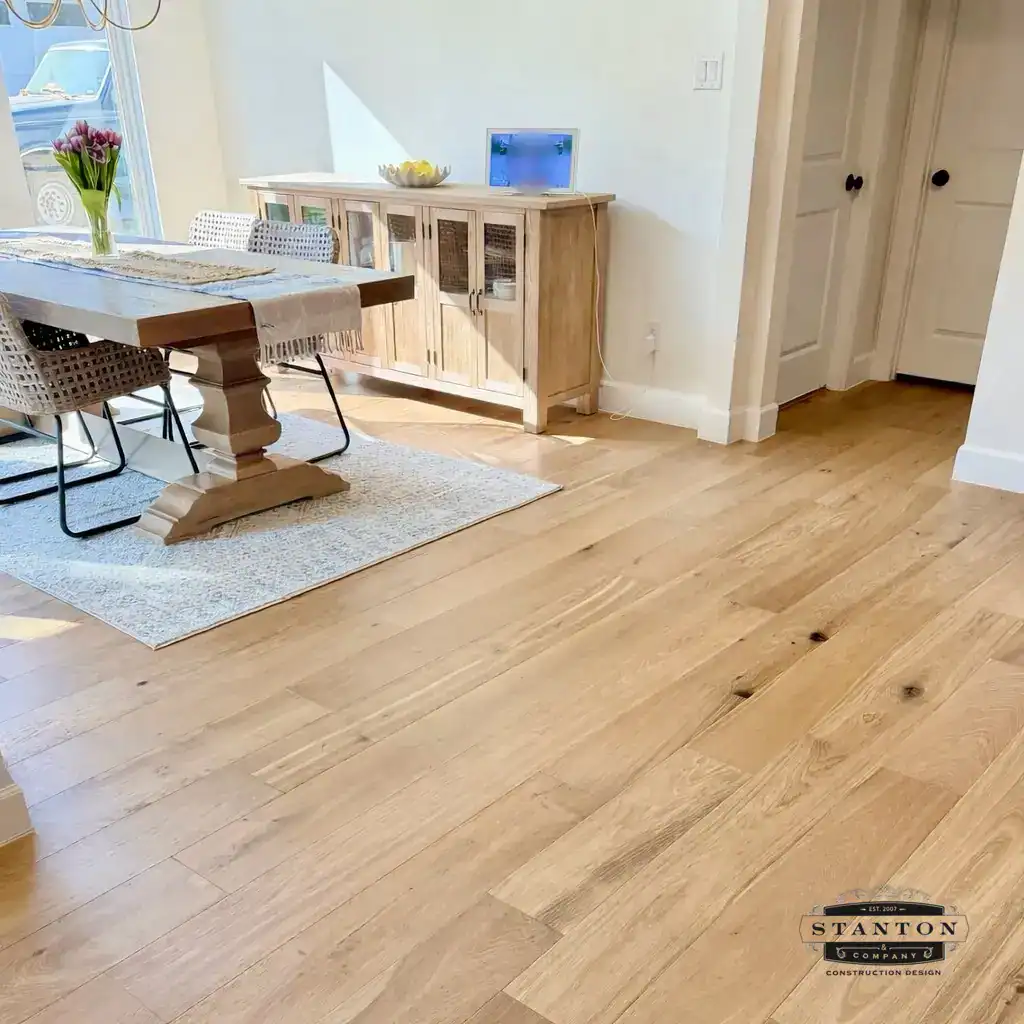
Engineered hardwood is a real wood product — a genuine hardwood veneer bonded to multiple layers of plywood or high-density fiberboard. It looks and feels like solid hardwood but is significantly more dimensionally stable in variable humidity environments. For the DFW area, it is generally the smarter wood flooring choice over solid hardwood in most applications.
Durability: Durable under normal residential use. Surface scratches and dents like solid hardwood — harder species like white oak, hickory, and maple outperform softer species. Can be lightly sanded and refinished two to three times depending on veneer thickness.
Fort Worth Climate: Holds a clear advantage over solid hardwood in our market. The cross-ply construction resists cupping, gapping, and buckling from North Texas humidity swings. Requires 48 to 72 hours acclimation before installation. Must not be installed below grade or in areas subject to moisture intrusion. A moisture barrier between slab and flooring is required and should never be skipped.
Allergy Considerations: Good choice for allergy-sensitive households. Hard surface traps no allergens. Specify GREENGUARD or FloorScore certified products to address potential VOC off-gassing from core adhesives.
Longevity: 25 to 40 years in a well-maintained, climate-controlled home. Veneer thickness determines refinishing cycles — specify 3mm or above for maximum lifespan.
Resale Value: Real wood floors are consistently cited positively by buyers. Engineered hardwood delivers the warmth and visual appeal of wood with better performance for our climate. A quality installation in main living areas is a meaningful value-add in the DFW market.
Installation: Can be installed floating, glued down, or nailed/stapled depending on product and subfloor. Glue-down or floating over concrete slab is typical. 48 to 72 hours acclimation required. Order 10% overage.
Pricing: $9–$18 per square foot installed. Premium species, wider planks, and custom finishes push toward the higher end.
Solid hardwood is a plank of wood milled from a single piece of timber. It is the most traditional and longest-lasting wood flooring option available, and it carries a premium perception no other product fully replicates. In the right application it is a lifetime floor. In the wrong application — or a home without consistent climate control — it can be a costly problem.
Durability: Can be sanded and refinished six to ten times over its life. A well-maintained solid hardwood floor can look new again decades after installation. Harder species — white oak, hickory, maple, Brazilian cherry — resist scratching and denting better than softer ones.
Fort Worth Climate: The most important conversation before choosing solid hardwood in the DFW area. Solid wood is hygroscopic — it absorbs and releases moisture with the environment. North Texas humidity swings are exactly the conditions that cause cupping in summer and gapping in winter. These are not installation failures — they are the natural behavior of solid wood in a variable humidity environment. Homes maintaining indoor humidity between 35 and 55 percent with no slab moisture issues can support solid hardwood successfully. All others are better served by engineered hardwood. Solid hardwood should never be installed over a concrete slab without a wood subfloor system and cannot be installed below grade.
Allergy Considerations: Excellent for allergy sufferers. Hard smooth surface harbors no allergens. Site-applied finishes should be low-VOC.
Longevity: A generational floor in the right environment. 50 to 100-year-old solid hardwood floors are common in well-maintained homes. Longevity depends entirely on maintaining a stable indoor environment.
Resale Value: The highest resale value impact of any flooring material. Buyers recognize and assign a value premium to solid hardwood. A meaningful differentiator in a competitive DFW listing.
Installation: Requires a wood subfloor — not concrete — typically nail or staple-down over plywood. Acclimation of 3 to 7 days mandatory. Moisture readings of wood and subfloor required before installation. Site-finished solid hardwood requires vacating the home during finishing and 24 to 48 hours afterward due to fumes and dust.
Pricing: $12–$25 per square foot installed for domestic species in standard widths. Wide-plank formats and premium species push toward $20–$35. Site-finishing adds labor cost but allows custom stain and sheen on-site.
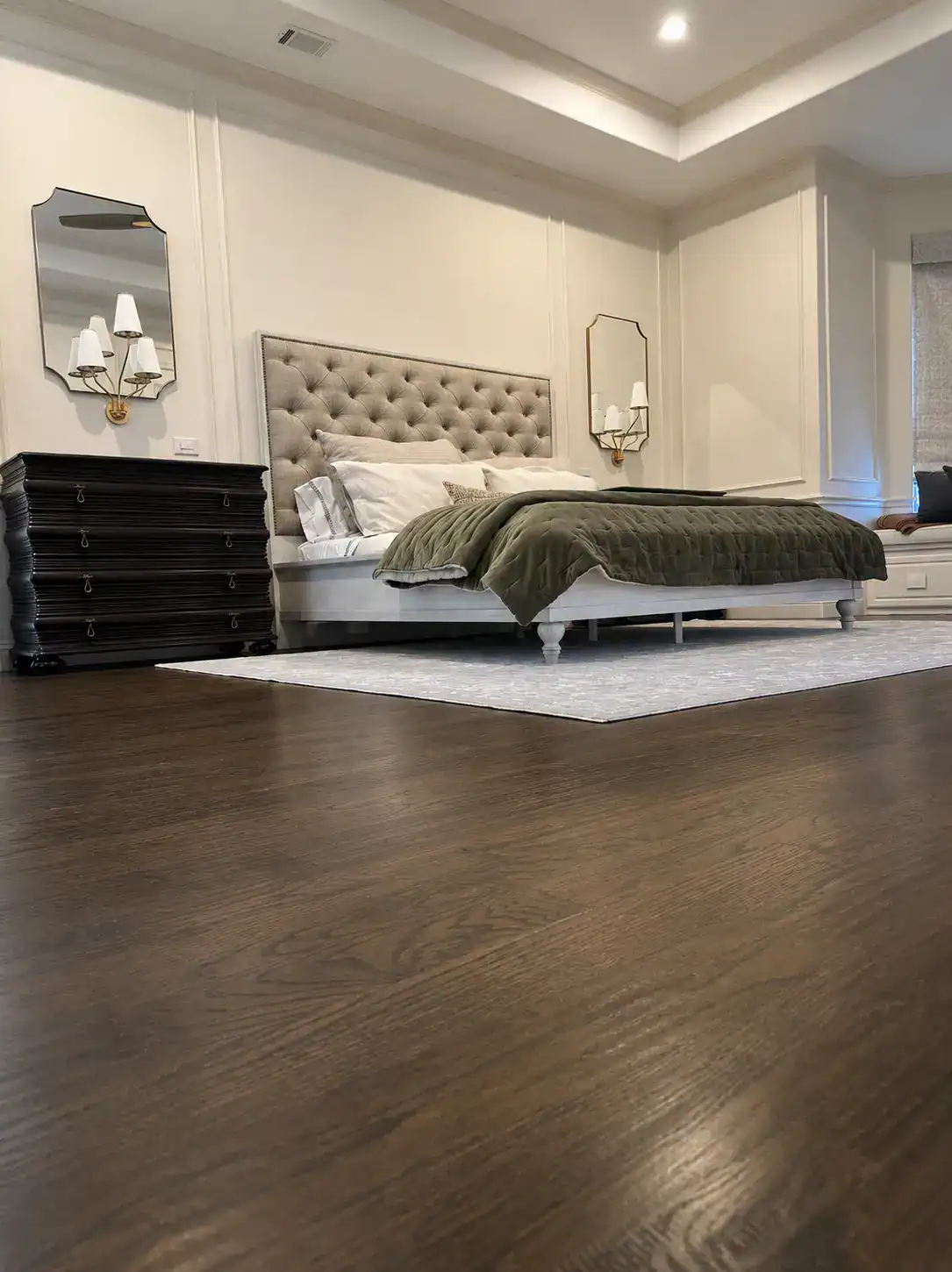
Carpet is the right choice for specific applications and the wrong choice for others. Bedrooms, media rooms, and bonus rooms where comfort and sound absorption matter are where it performs best. Kitchens, bathrooms, entries, and high-traffic living areas are where it falls short. A thoughtful flooring plan for most Fort Worth homes uses carpet selectively, not universally.
Durability — Fiber Types:
Nylon is the most durable residential fiber — resilient, crush-resistant, and appropriate for high-traffic areas. Polyester (PET) offers excellent stain and fade resistance with a soft feel, and is increasingly made from recycled materials — best for bedrooms and lower-traffic spaces as it compresses more readily than nylon under heavy use. Olefin (polypropylene) is solution-dyed for exceptional fade resistance and resists moisture and mildew well, but is oleophilic — it attracts oil-based soils and can mat down over time in heavy traffic. Triexta (Smartstrand) is a newer fiber offering nylon-level durability with polyester softness. Wool is the premium natural fiber — durable, naturally soil-resistant, and long-lasting, with a significant price premium. Pile construction, twist level, and face weight all affect performance. Quality carpet with proper padding lasts 10 to 15 years in appropriate applications.
Fort Worth Climate: Moisture is the primary concern. Carpet over a damp slab is a mold risk. Moisture testing before installation is important in older homes. Never install carpet in spaces prone to moisture or flooding. In bedrooms and upstairs areas of well-maintained homes the concern is minimal.
Allergy Considerations: Carpet’s most discussed limitation. Fibers trap dust, dander, and pollen that accumulate between cleanings. Some research suggests carpet may reduce airborne allergens by trapping rather than circulating them — provided it is vacuumed regularly with a HEPA-filter vacuum. For households with severe allergies or asthma, hard surface flooring is the better recommendation.
Longevity: 10 to 15 years in appropriate applications; 7 to 10 in high-traffic areas or stairs. The shortest lifespan of all materials covered here. Cannot be refinished — replacement is the only option.
Resale Value: Neutral to mildly positive in bedrooms. Increasingly a negative in main living areas where buyers expect hard surfaces. Worn, stained, or dated carpet should be replaced before listing — even a neutral mid-grade product almost always pays off.
Installation: Stretched over tack strip and padding. More forgiving of minor subfloor imperfections than hard surface products. Seaming requires skill in large or irregular rooms. Immediately livable after installation — no drying or cure time. Manufactured in 12-foot widths; rooms wider than that require a seam. Padding quality matters as much as carpet quality.
Pricing: $4–$10 per square foot installed including pad and installation for quality residential products. Premium wool pushes above that range. The most cost-effective option for bedrooms and secondary spaces.
Every home and every homeowner is different, but as a general reference for Fort Worth-area remodels:
Flooring selection involves more variables than most homeowners expect — your foundation type, the rooms being floored, how you live in the space, your household’s needs, and what the rest of your design looks like all factor into the right recommendation. What works in a Southlake home with a wood subfloor and consistent climate control may be the wrong choice for an older slab-on-grade home in Benbrook with humidity challenges.
At Stanton & Co., flooring selection happens at our Design Center & Showroom on Camp Bowie Blvd. in Fort Worth — and it is a true showroom, not a sample board on a wall. We carry an extensive selection across all flooring categories covered in this blog: porcelain tile in a wide range of sizes, formats, and finishes; natural stone tile including granite, marble, and travertine; LVP in dozens of colors, textures, and plank widths; engineered hardwood in multiple species and stain options; solid hardwood selections; and carpet samples across fiber types, pile styles, and price points. Whatever your budget, we have options that perform well and look great within it. Our design consultants help you find the right material for your space, your household, and your price point — not the product with the best margin. You’ll see actual samples at full scale alongside your cabinet, countertop, and hardware selections so every decision gets made together rather than in isolation.
As we’ve noted throughout the BLOGS series, the design phase is where budget is protected and problems are prevented. Flooring decisions made before demolition begins mean no surprises, no change orders, and no delays waiting on product that wasn’t ordered in time.
If new flooring is part of your upcoming remodel — whether it’s one room or the whole house — the best first step is a conversation. We’ll come walk your space, assess the conditions, understand what you want, and help you select the right product before anything comes up off the floor.
To schedule a free in-home consultation and estimate, call 817.731.5855 ext. 1 or reach us through our online Contact Form on our website. You can also visit our Design Center at 4824 Camp Bowie Blvd., Fort Worth.
How Much Does a Kitchen Remodel Cost in the Fort Worth, Texas Area?
How Much Does a Bathroom Remodel Cost in the Fort Worth, Texas Area?
What to Expect When You’re Remodeling: A Homeowner’s Complete Preparation Guide
Granite, Quartz, Quartzite, or Marble: Choosing the Right Countertop for Your Fort Worth Remodel
Proudly Serving the DFW Metroplex
Stanton & Company provides full-service residential remodeling, custom cabinetry, countertops, flooring, and design services to homeowners throughout the Dallas–Fort Worth area, including Fort Worth, Benbrook, Aledo, Willow Park, Hudson Oaks, Weatherford, Brock, Keller, the Mid-Cities (Euless, Bedford, Hurst), North Richland Hills, Southlake, Colleyville, Argyle, Arlington, Pantego, Mansfield, Kennedale, Burleson, and Crowley. Visit our Design Center on Camp Bowie Blvd. or call 817.731.5855 ext. 1 to schedule a consultation.
Explore more remodeling tips, material comparisons, and project guidance from Stanton & Company.
If you’re outgrowing your home in Fort Worth, Keller, Southlake, Mansfield, Arlington, or Aledo, you’re facing one of th …

Stanton & Co. is known for detailed, thoughtful, well-planned remodels. The photos of newly renovated kitchens, bath …

The kids are back in school, the schedule is starting to settle into its Fall rhythm, and if you are like most homeowner …
4824 Camp Bowie Blvd.
Fort Worth, Texas 76107
817.731.5855
Open 9am-5pm (M-F)
Open 10-2 (Sa)
6623 Corporation Parkway – Suite 140
Fort Worth, Texas 76126
817.441.2790
Open 8am-5pm (M-F)
© Copyright 2026 - 2026 Stanton and Company, Inc, All Rights Reserved. | Website Design by WABW Media Group