

Your Fall Home Maintenance Checklist for the Fort Worth Area
Fall is one of the best times of year to get ahead of home maintenance. North Texas Falls are short and unpredictable, w …
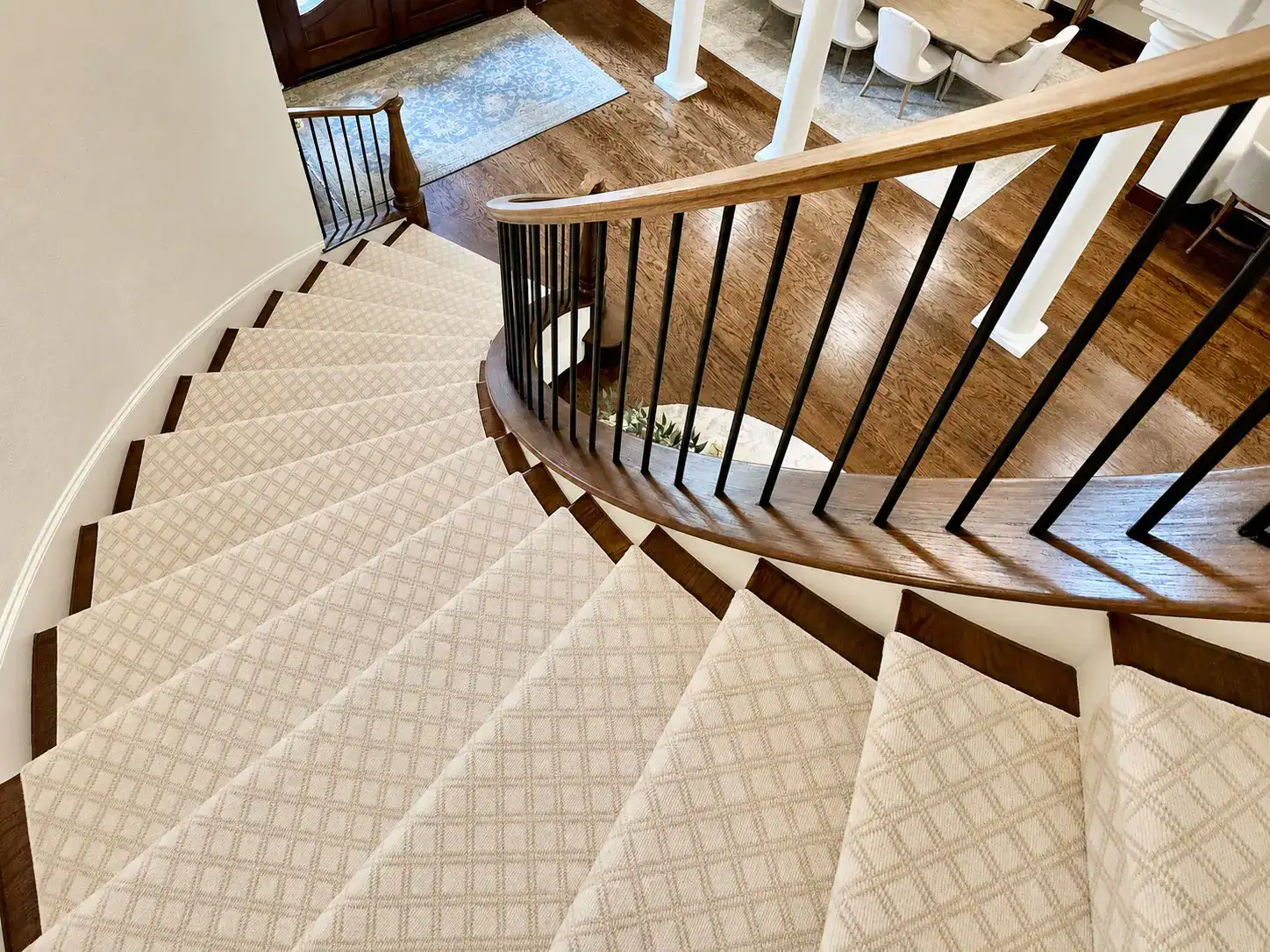
Hard surfaces — LVP, tile, hardwood — have dominated remodeling trends over the past decade, and many homeowners have ripped out carpet throughout their homes without stopping to ask whether that was the right call in every room. The honest answer is that carpet is not right for every space, but it is still a good choice for some of them. Knowing the difference saves money and produces a better-performing home.
At Stanton & Co., homeowners across Fort Worth, Keller, Southlake, Mansfield, Arlington, Aledo, and the surrounding area frequently ask our opinion about the right choice for flooring in certain areas of a home. This article imparts some basic knowledge to help you make an informed decision about where carpet is a good choice, what type performs best in those spaces, and where a custom rug might be the better fit. Our goal is always to meet the needs of our customers in comfort, durability, pricing, and overall aesthetic.
Bedrooms are where carpet continues to make the most sense. The softness and warmth underfoot when you step out of bed in the morning, the sound absorption that keeps a bedroom quiet, the comfort for children playing on the floor — these are genuine functional benefits that no hard surface fully replicates. In a bedroom, carpet is not a compromise. It is a logical choice.
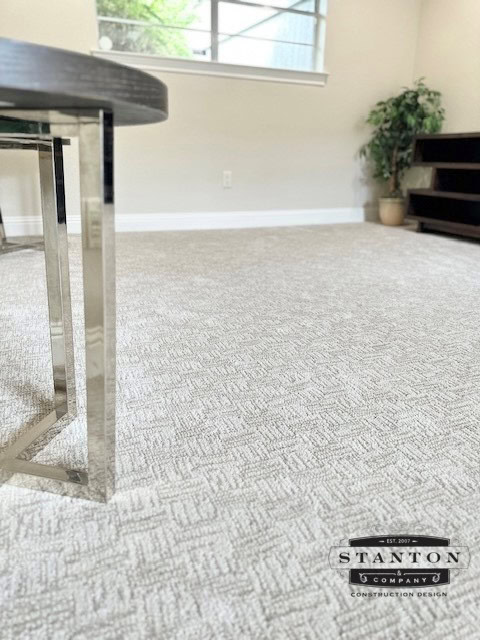
Media rooms and bonus rooms with home theater setups benefit from carpet’s sound absorption properties. A carpeted media room performs acoustically in a way that a hard-surface room does not, without expensive acoustic panels and treatments.
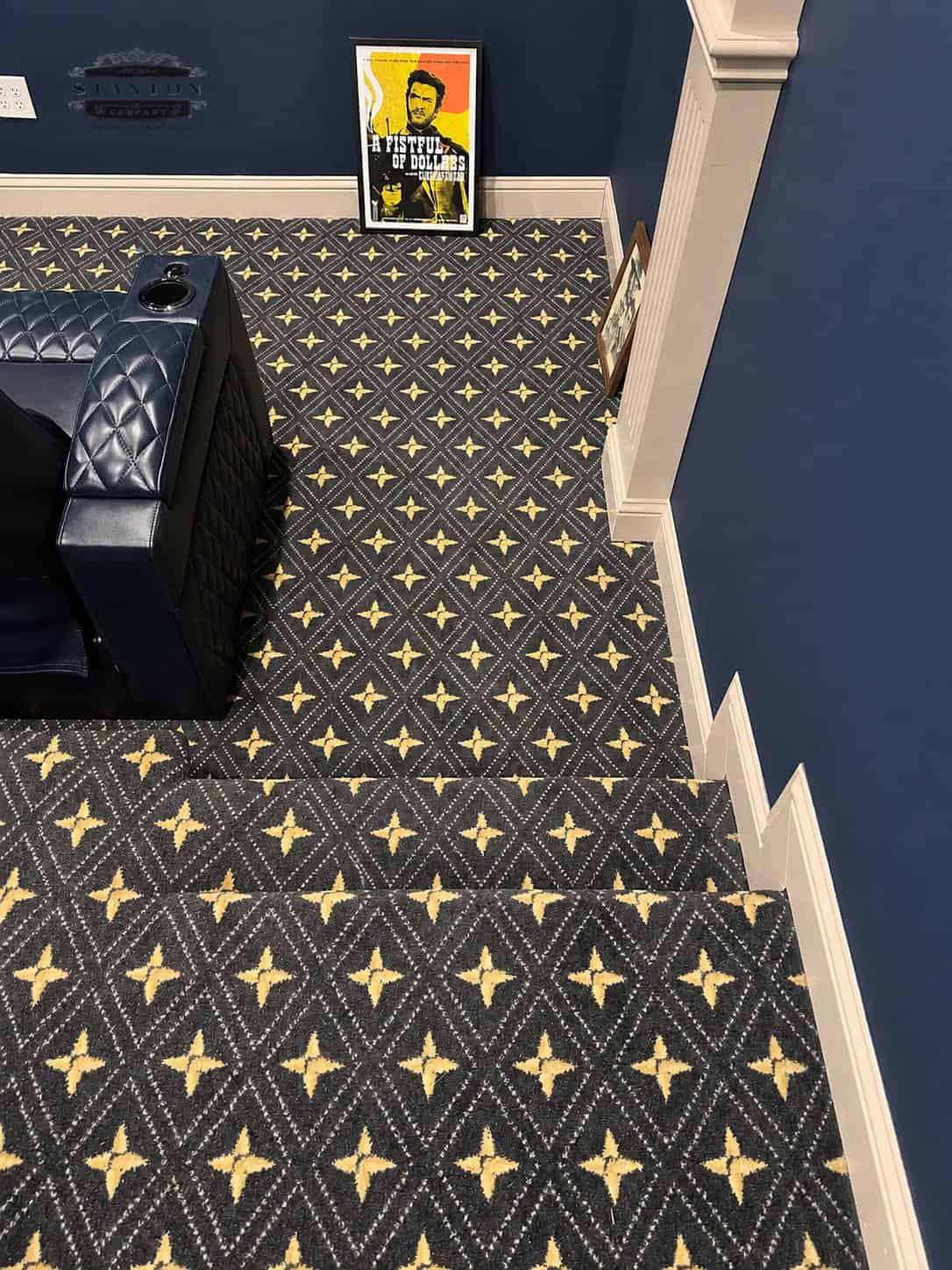
Secondary bedrooms, guest rooms, and playrooms are also strong candidates. The lower cost of carpet relative to hard surfaces makes it a practical choice for spaces that see moderate use and where budget is better allocated to the kitchen, bathrooms, and main living areas.
Kitchens, bathrooms, laundry rooms, and any space with moisture exposure are not appropriate applications for carpet in a Fort Worth home. North Texas humidity, combined with slab-on-grade foundations that can wick moisture upward, creates conditions where carpet in the wrong location becomes a mold risk over time. Carpet over a damp slab is a problem waiting to happen. Porcelain tile is the correct specification for these wet areas. We cover the reasoning in detail in our Comparing Porcelain, Ceramic, and Natural Stone for a Flooring Remodel in Fort Worth, Texas blog.
Main living areas, entryways, dining rooms, and high-traffic hallways have largely moved to hard surfaces — and for good reason. Buyers expect hard surfaces in these spaces, and carpet in a main living area is increasingly a negative in a resale context. If your home still has carpet in the living room or entry, replacing it with LVP, engineered hardwood, or tile before listing is usually a worthwhile investment. Our Is LVP Flooring a Good Choice for North Texas Homes? blog and our Engineered Hardwood vs. Solid Hardwood: Which Is Right for Your Fort Worth Home? blog cover the two most popular replacement options in detail.
Not all carpet is equal, and the fiber type is the most important factor in how a carpet performs over time. Here is a plain-language breakdown of the main options:
Nylon: The most durable residential fiber. Resilient, crush-resistant, and appropriate for any room in the home including higher-traffic areas like hallways and stairs. Cleans well and holds its appearance longer than other synthetic fibers. The best all-around choice for active households.
Polyester (PET): Excellent stain resistance and a very soft feel — often the softest option on the showroom floor. Increasingly made from recycled materials. The trade-off is that polyester compresses under sustained heavy traffic more quickly than nylon. Best for bedrooms and lower-traffic spaces where softness is the priority.
Olefin (Polypropylene): Solution-dyed, which means color is built into the fiber and is exceptionally fade-resistant. Highly resistant to moisture, mold, and mildew. Frequently used in berber-style carpets. The limitation is that olefin attracts oil-based soils — it can be difficult to clean greasy or oily stains and may mat down over time in heavy traffic.
Triexta (Smartstrand): A newer classification that delivers nylon-level durability with polyester softness. A strong mid-to-upper-range option for households that want performance and feel without choosing between them.
Wool: The premium natural fiber. Durable, naturally soil-resistant, inherently resilient, and the longest-lasting option on this list. Carries a significant price premium. For homeowners who prioritize natural materials and long-term performance, wool is a legitimate investment.
Fiber is only half of the equation. How that fiber is constructed into the carpet — the pile — has just as much influence on how a carpet looks, feels, and wears. Here are the constructions we see most often in Fort Worth-area homes:
Cut pile: The yarn loops are cut at the top, leaving individual upright tufts. This produces the softest, most plush feel underfoot and includes familiar styles like plush, saxony, and frieze (a twisted, textured cut pile that hides footprints and vacuum marks better than a smooth plush). Cut pile is the right choice for bedrooms and formal living areas where comfort and appearance matter most.
Berber and loop pile: The yarn is looped through the backing and left uncut, creating a durable, low-profile surface. Berber — the most recognizable loop style — handles heavy foot traffic exceptionally well and resists crushing and matting, which makes it a strong choice for hallways, stairs, and family rooms. The trade-off is a firmer feel underfoot than cut pile, and loop styles can snag if a household has cats.
Cut and loop (sculptured or patterned): This construction combines cut tufts and uncut loops in the same carpet, creating a textured, three-dimensional pattern. It hides dirt and footprints well and offers more visual interest than a single-level pile, making it a popular choice for family rooms and transitional-style homes.
As a general rule: loop pile and Berber construction hold up best under heavy traffic, cut pile delivers the most comfort and formality, and cut-and-loop sculptured carpet offers a middle ground of texture and durability. The right construction depends on the room as much as the fiber.
In a two-story remodel, stairs are one of the places where carpet can deliver the most practical benefit, both aesthetically and acoustically. Hard-surface stairs — wood or tile — are among the loudest surfaces in a home. Every footstep, every dropped toy, every trip up or down transmits noise directly through the stairwell and into the rooms above and below. A carpeted stair or a stair runner absorbs that impact noise significantly, which matters most in homes with an open floor plan where the staircase sits near a living area, or in households with kids and pets moving up and down throughout the day.
Safety is the other major advantage. Carpet provides traction that hard-surface stairs do not, which matters for young children, older homeowners, and anyone carrying something up or down. It also softens a fall in a way that wood or tile simply cannot.
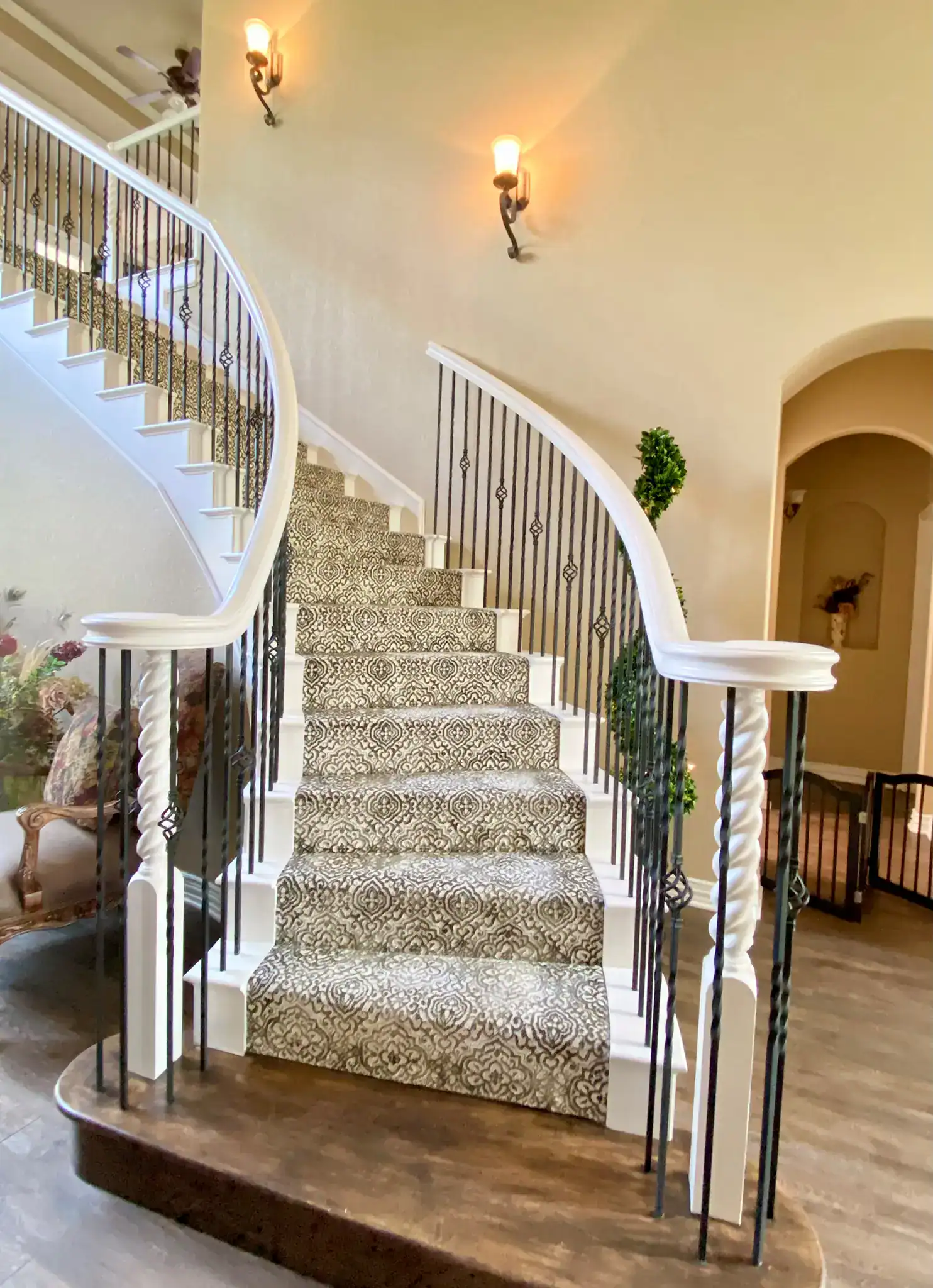
A full stair carpet covers each tread completely, edge to edge. A stair runner is a narrower strip of carpet installed down the center of each tread, leaving the wood tread and riser exposed on either side — a popular choice for homeowners who want to preserve the look of a wood staircase while gaining the sound and safety benefits of carpet where it counts. Both approaches call for a durable, tightly constructed fiber. Stairs see repeated point-loading at the nose of each tread, so a dense loop pile or Berber construction in nylon typically outperforms a plush cut pile in this application, and a stain-resistant fiber is worth the investment given how visible stairs are in a home. Installation on stairs also requires a specific technique — typically either a waterfall method, where the carpet flows continuously over the nose of each tread, or a cap-and-band method, which wraps and finishes each stair individually for a more tailored look. Either is a job for an experienced installer, since stairs see more wear and more visible seams than any flat floor in the house and are typically one of the first things people see when entering a home.
Not every homeowner wants wall-to-wall carpet, and not every room needs it. A custom area rug is one of the most effective ways to bring warmth, softness, and texture into a room without carpeting the entire floor — and it is an option many homeowners do not realize is available through their remodeling contractor.
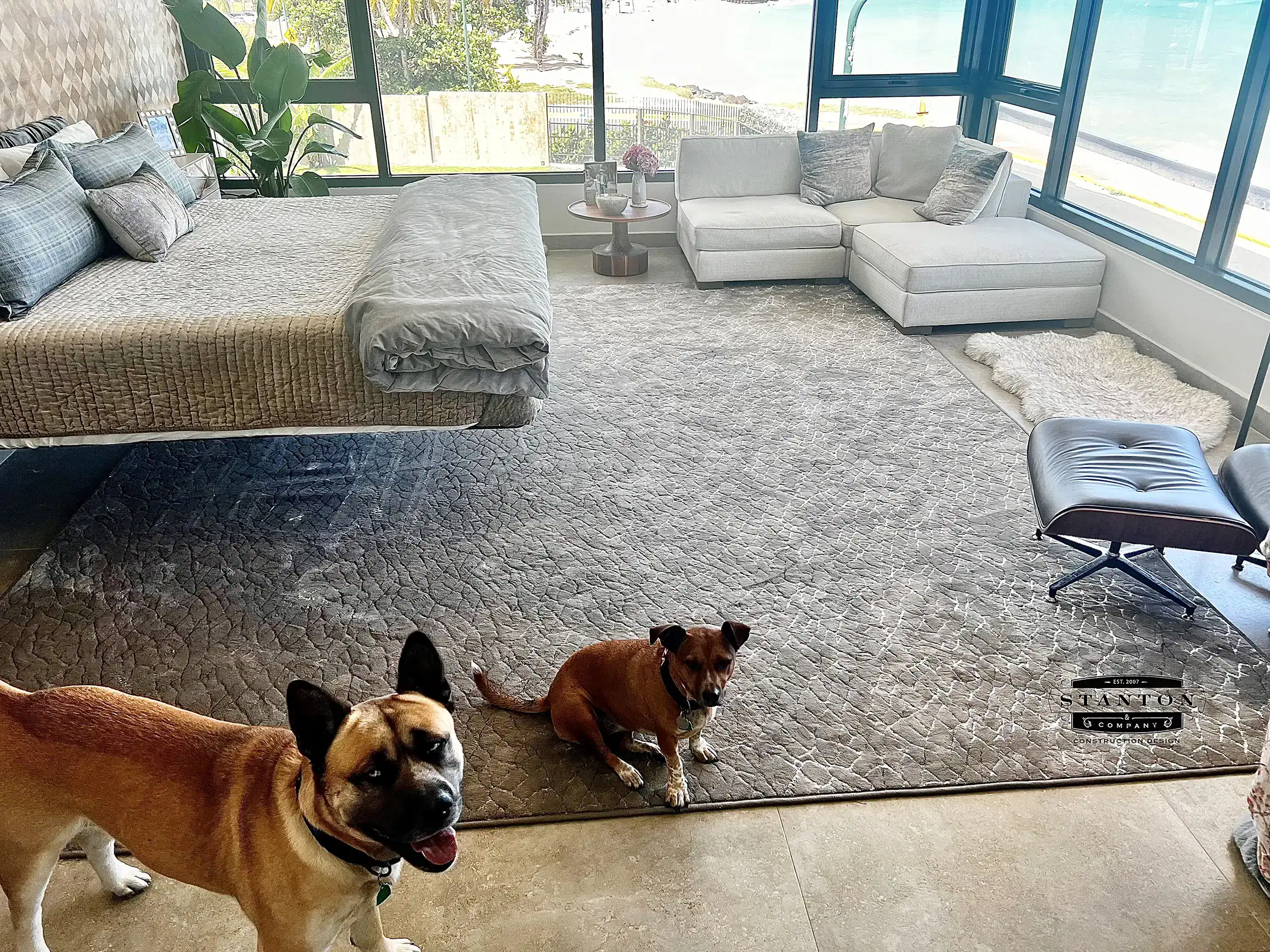
At Stanton & Co., we can create a custom rug from virtually any carpet in our showroom — nylon, wool, patterned cut-and-loop, you name it. A carpet remnant or a cut piece of any broadloom carpet can be finished into a rug with a proper edge treatment, which is what separates a professional custom rug from a raw, fraying piece of carpet. The two industry-standard finishing methods are binding and serging. Binding wraps a fabric or synthetic tape around the edge and sews it in place for a clean, tailored border. Serging wraps yarn continuously around the edge to create a soft, hand-finished look that often matches the carpet’s own color. Both methods prevent the edge from unraveling and both can be color-matched or contrasted against the rug for a finished, first-class result — the choice comes down to the look you want and where the rug will live.
A custom rug lets you bring the exact fiber, color, and texture you want into a room — a plush wool rug under a dining table, a durable nylon rug in a busy playroom, a bound cut-and-loop rug in an entry — all sized precisely to the space, rather than settling for a standard manufactured size that almost fits. It is a detail worth discussing during your design consultation, whether you are finishing a single room or rounding out a full remodel.
Padding quality matters as much as carpet quality — and it is often the first thing cut when a budget gets tight. A quality pad extends the life of the carpet above it, improves comfort underfoot, and provides additional sound absorption. Do not let a contractor talk you into a thin, low-density pad under a quality carpet. The combination of a good carpet and a cheap pad is a waste of the carpet investment.
The conventional wisdom is that carpet is bad for allergy sufferers. The reality is more nuanced. Carpet fibers do trap dust, pet dander, pollen, and other allergens — which means they accumulate between cleanings. For households with severe allergies or asthma, hard surface flooring throughout is generally the better recommendation.
That said, some research suggests that carpet can actually reduce airborne allergen levels by trapping particles in the fiber rather than allowing them to circulate in the air — as long as the carpet is vacuumed regularly with a HEPA-filter vacuum. A carpet that is vacuumed twice a week may present fewer airborne allergens than a hard floor that is swept once a week. The key phrase is regular cleaning. For households willing to maintain that discipline, carpet in bedrooms is not necessarily the allergy problem it is often made out to be.
Carpet is generally an affordable flooring option in the residential market. Installed pricing in the Fort Worth area runs $4–$10 per square foot for quality residential products including pad and installation. Premium wool or specialty fiber carpets push above that range. At the lower end, you are getting a functional, decent-looking floor. At the higher end, you are getting a product that will perform well for 12 to 15 years and look good doing it.
The lifespan reality is worth stating plainly: quality carpet in appropriate applications lasts 10 to 15 years. In high-traffic areas or stairs, 7 to 10. Unlike hardwood, it cannot be refinished. When it reaches the end of its life, it must be replaced. Factor that into the long-term cost comparison against hard surfaces that may last 25 to 50 years.
Carpet is not the right choice for every room, but in bedrooms, media rooms, and secondary spaces, it remains the most comfortable, most acoustically effective, and most cost-efficient option available. A thoughtful flooring plan for a Fort Worth home typically uses hard surfaces in main living areas, kitchens, and bathrooms, and carpet selectively in sleeping and media spaces — with a custom rug as an easy way to add warmth anywhere a hard surface feels too bare. That combination produces a home that is practical, comfortable, and appropriate for the North Texas climate.
For a full comparison of all flooring materials, see our [Choosing the Right Flooring for Your Fort Worth Area Remodel: A Comprehensive Guide] blog. To schedule a free in-home consultation and estimate, call 817.731.5855 ext. 1 or reach us through our Contact Form. You can also visit our Design Center at 4824 Camp Bowie Blvd., Fort Worth.
Proudly Serving the DFW Metroplex
Stanton & Company provides full-service residential remodeling, custom cabinetry, countertops, flooring, and design services to homeowners throughout the Dallas–Fort Worth area, including Fort Worth, Benbrook, Aledo, Willow Park, Hudson Oaks, Weatherford, Brock, Keller, the Mid-Cities (Euless, Bedford, Hurst), North Richland Hills, Southlake, Colleyville, Argyle, Arlington, Pantego, Mansfield, Kennedale, Burleson, and Crowley. Visit our Design Center on Camp Bowie Blvd. or call 817.731.5855 ext. 1 to schedule a consultation.
Explore more remodeling tips, material comparisons, and project guidance from Stanton & Company.
Fall is one of the best times of year to get ahead of home maintenance. North Texas Falls are short and unpredictable, w …

The remnants of Hurricane Polo brought heavy rain and flooding to areas around Fort Worth this week. In light of Hurrica …
Sometimes your family has outgrown the house you love. If you are a homeowner in Fort Worth, Keller, Southlake, Mansfiel …
4824 Camp Bowie Blvd.
Fort Worth, Texas 76107
817.731.5855
Open 9am-5pm (M-F)
Open 10-2 (Sa)
6623 Corporation Parkway – Suite 140
Fort Worth, Texas 76126
817.441.2790
Open 8am-5pm (M-F)
© Copyright 2026 - 2026 Stanton and Company, Inc, All Rights Reserved. | Website Design by WABW Media Group